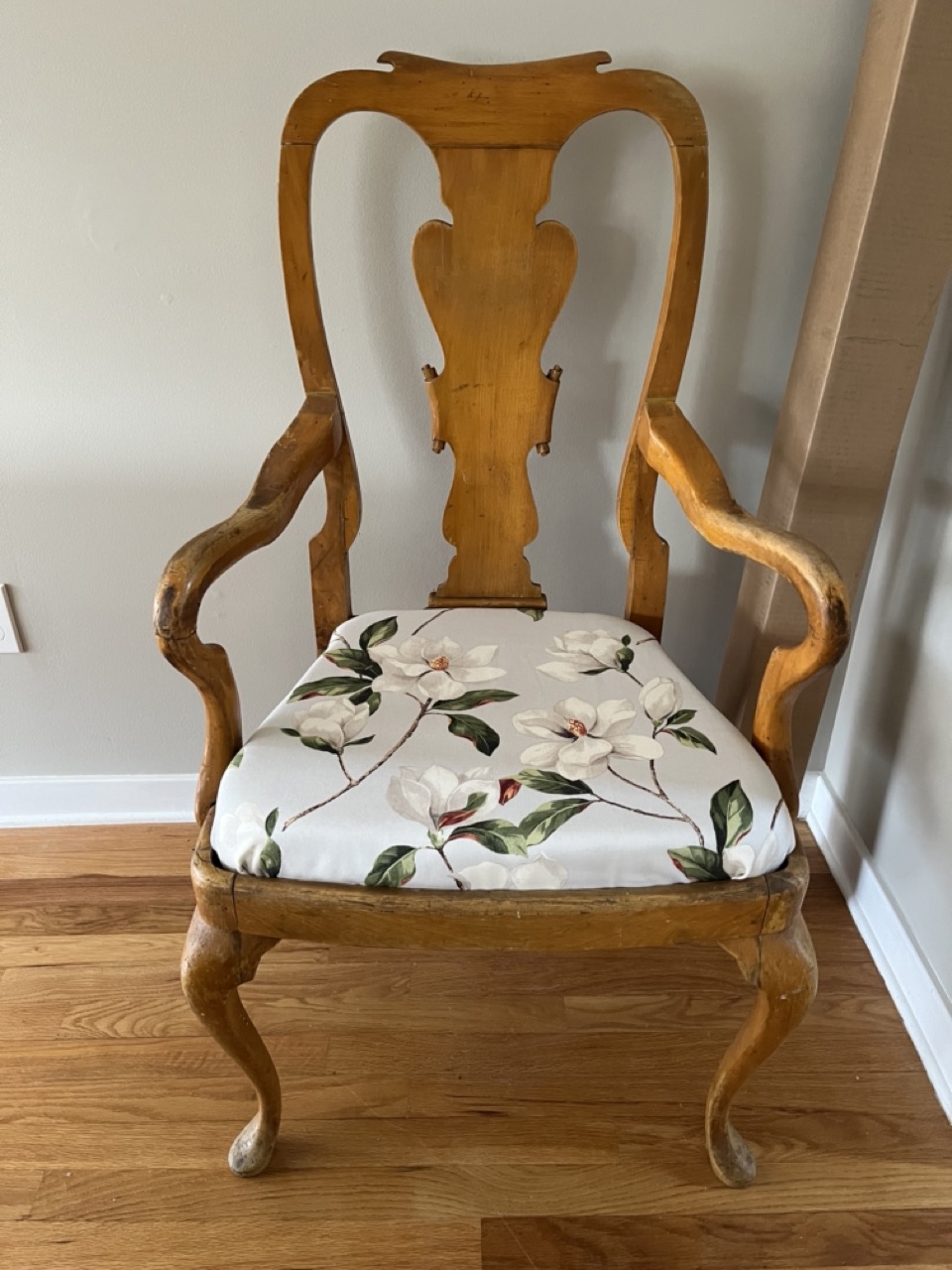
Sometimes life gives you lemons. And sometimes life gives you free furniture.


We like things well-constructed. And we like to buy from reputable companies. This usually means that we like expensive things. Which is a pain when the bank balance doesn’t reflect the desire. Which is why we find reupholstering furniture a useful skill.
When we moved from California to Connecticut, we traded a 1200sqft ranch house for a 3600sqft modern colonial. We thought we could afford it, but we forgot to factor in buying more furniture, to fill up all the empty rooms. What to do when you need more chairs than money can provide? Well, sometimes, when you’re really lucky, and your heart is pure and good, the universe provides.
So it was, that on our way home from a morning hike Spud and I spotted a couple of beautiful mismatched antique chairs on the side of the road. Were they free? Were they awaiting pick up? We checked with the owner (a sweet woman, in her pink dressing gown and fuzzy slippers), who was delighted we wanted to take the seats and give them a new lease on life. Huzzah! Free chairs! Now… to fit them in the back of the 4Runner…
Jokes! The 4Runner is basically a pickup with a roof. Of course the chairs fit!


It was obvious from the outset, that one of the chairs needed fresh upholstery. I’d reupholstered a dining chair years ago, but that one had a solid wood base, so this chair was a fresh challenge.
Word of warning. Always wear a mask when dismantling an old seat, before you unleash forty-plus years of dust into your airspace—Ick!


I was a big fan of Joann, and bought everything I needed from my local store before it closed down: webbing, batting, interfacing, seat foam, and upholstery fabric. I already had the staples and staple gun from previous reupholstering projects. If you want to undertake a similar activity involving cutting foam I highly recommend industrial scissors (the red and black ones in the photo). You can do it with a Stanley knife, but the scissors provide better control.


The most difficult part was choosing the fabric. I wanted a hard-wearing upholstery fabric, but that still left hundreds of designs to choose from.
Plus, I’m easily distracted by fabric with pink corgis and pineapples wearing sunglasses. Thankfully, Spud has a knack of calling me back from the type of purchases I might love for a month before I start wondering how much Sambuca I was drinking when I hit the “buy now” button.

Ta da! Bold but classy magnolia print for the win! My reupholstering project is complete. Now all the chair needs is a light sand, and some fresh stain.
How do you know whether a fabric will stand the test of time?
Look for the number of rubs. This counts essentially how many times a butt can sit on a chair before the fabric starts to pill and thin.
So, thicker fabric is best when reupholstering?
A thicker fabric doesn’t necessarily mean a high rub. Plus, keep in mind a thicker fabric will be more difficult to handle when reupholstering. Look for a fabric with a high rub, but an easy drape (often described as medium or light weight). The thinner the fabric the easier it will be to curve over edges and fold around corners. Just don’t go too thin, or the foam and batting might show through.