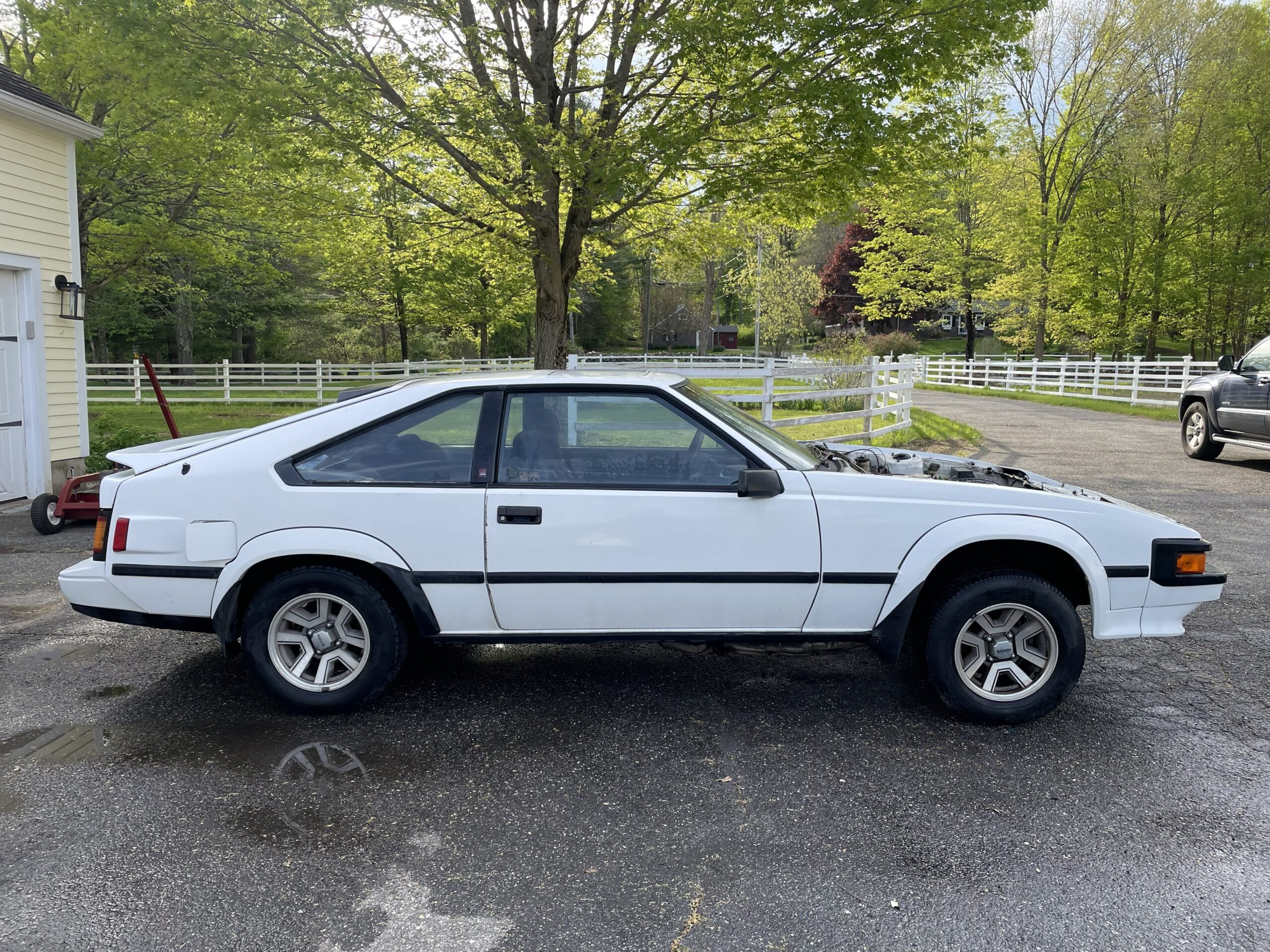
There are some car projects that start with a sensible plan.
And then there are the ones that start with a daydream, a late-night YouTube spiral, and the quiet realization that normal was never really the goal.
Welcome to Project Snowball – a 1985 Celica Supra restomod, powered by a Mercedes-Benz M120 V12 – the engineering, the setbacks, the breakthroughs, and the moments where I question my sanity (which I suspect will be frequent).
Yes… that kind of snowball.
If you’re into unusual swaps, high-revving naturally aspirated engines, or the idea of mixing 1980s Japanese styling with German V12 excess, you’re in the right place.
Why the Mk2 Supra?
I’ve been a Mk2 Supra fan since the 1990s.
To me, the Celica Supra is the epitome of the Japanese 80s sports car: long hood, sharp lines, pop-up headlights, and that unmistakable wedge profile that looks like it belongs in a neon-lit Tokyo street race or parked outside an arcade.
Back when the internet was still young and engine swaps were not something you could buy a kit for, I completed and fully documented one of the earliest 7M‑GTE conversions into a Mk2 – a Toyota turbo six fitted into a chassis that always had the potential for more power than it received from the factory.
And that’s really the Mk2 Supra’s only flaw.
It has the styling.
It has the balance.
It’s just… a bit down on power.
Project Snowball is my attempt to fix that in the most absurd way possible.
Enter the Mercedes M120 V12
So why a Mercedes V12?
Why not something simpler, lighter, cheaper, more supported, and more rational?
A 2JZ?
An LS?
Because this build was never about rational.

The engine at the heart of this Celica Supra restomod is the Mercedes-Benz M120, a 6.0-liter naturally aspirated V12 developed in the 1990s – an era when Mercedes still built engines with a kind of over-engineered confidence that feels almost impossible today.
The M120 is an all-aluminum, quad-cam, 48-valve masterpiece. It powered cars like the 600SEL and SL600, delivering turbine-smooth torque with the refinement of a luxury flagship.
But underneath that polite exterior is something much more interesting:
A big-displacement V12 that responds incredibly well to breathing mods, camshaft work, compression, and rpm – especially when freed from the constraints of luxury-car tuning.
And perhaps most importantly…
It has the potential to sound like nothing else.
The Spark: Sasaki and the F1 Sound
The true origin of this engine choice comes down to one thing:
Sound.
Years ago, I stumbled across this grainy YouTube video of Sasaki’s (Brilliant) exhaust engineering – the kind of footage that looks like it was filmed on a flip phone, but sounds like it was recorded at Monza in 1998.
Sasaki had built an M137-based V12 with an exhaust note so sharp, so mechanical, so violently alive that it genuinely resembled an old Formula 1 car.
That was the moment the seed was planted.
The idea that a road-based Mercedes V12 could be transformed into something theatrical – something operatic – was completely irresistible.
I’ve always had a passion for the mechanical soundscape of racecars: the intake roar, the cammy idle, the metallic scream at redline.
To me, a great car isn’t just transportation – it’s theatre.
It’s pantomime.
It’s mechanical music.
Project Snowball is, in many ways, an attempt to build my own version of that experience.
The Pagani Connection
And of course, there’s another reason the M120 has become legendary:
Pagani.
The M120 was the foundation for the engines used in the Pagani Zonda, one of the most iconic hypercars ever built. The Zonda’s sound is widely considered one of the greatest in automotive history – a shrieking, multi-throttle V12 symphony that feels more like motorsport than road car.
Now, I’m not pretending this Supra is going to become a Zonda.
But the fact that this same engine architecture helped power one of the most emotional cars ever created?
That matters.
It tells you what the platform is capable of.
What’s the Main Goal of my Celica Supra Restomod?
Project Snowball is not a dedicated racecar.
And it’s not a showpiece trailer queen.
The goal is something far more specific:
A weekend street car that could be equally at home at a cars-and-coffee meet…
Or hammering around a track day with a V12 singing at full song.
A Celica Supra restomod that keeps the spirit of the Mk2 Supra intact, but elevates it into something truly special.
The Lofty Goals of my Celica Supra Restomod
I’ll be honest: I have some ambitious targets for this build.
- Sub-3 second 0–60 mph
- Sub-10 second quarter mile
- Under 3,000 lbs curb weight
Those numbers are serious – especially for a naturally aspirated setup.
And that brings me to the philosophical fork in the road:
If at all possible, I want this car to remain NA.
Not because forced induction isn’t effective – it absolutely is – but because nothing matches the immediacy and sound of a high-compression, high-rpm naturally aspirated engine.
That’s where the magic lives.
That said…
I’m leaving the door open.
If the performance goals can’t realistically be met without boost, then supercharging may enter the conversation later.
But the dream is clear:
A screaming NA V12 Mk2 Supra that feels like an 80s sports car possessed by something from Le Mans.
Follow Along with my Celica Supra Restomod
This is just the beginning.
In upcoming posts, I’ll be documenting:
- The engine build direction (cams, compression, rpm)
- Packaging the V12 into the Mk2 chassis
- Dry sump plans
- Exhaust design (the heart of the project)
- Weight reduction and chassis modernization
- The inevitable unexpected problems

Project Snowball is already rolling downhill – and as anyone who has taken on a build like this knows, it only gets bigger from here.
If you’re interested in weird swaps, naturally aspirated engine obsession, or the pursuit of the perfect mechanical soundtrack…
Stay tuned.
This one is going to be fun.
Leave a Reply