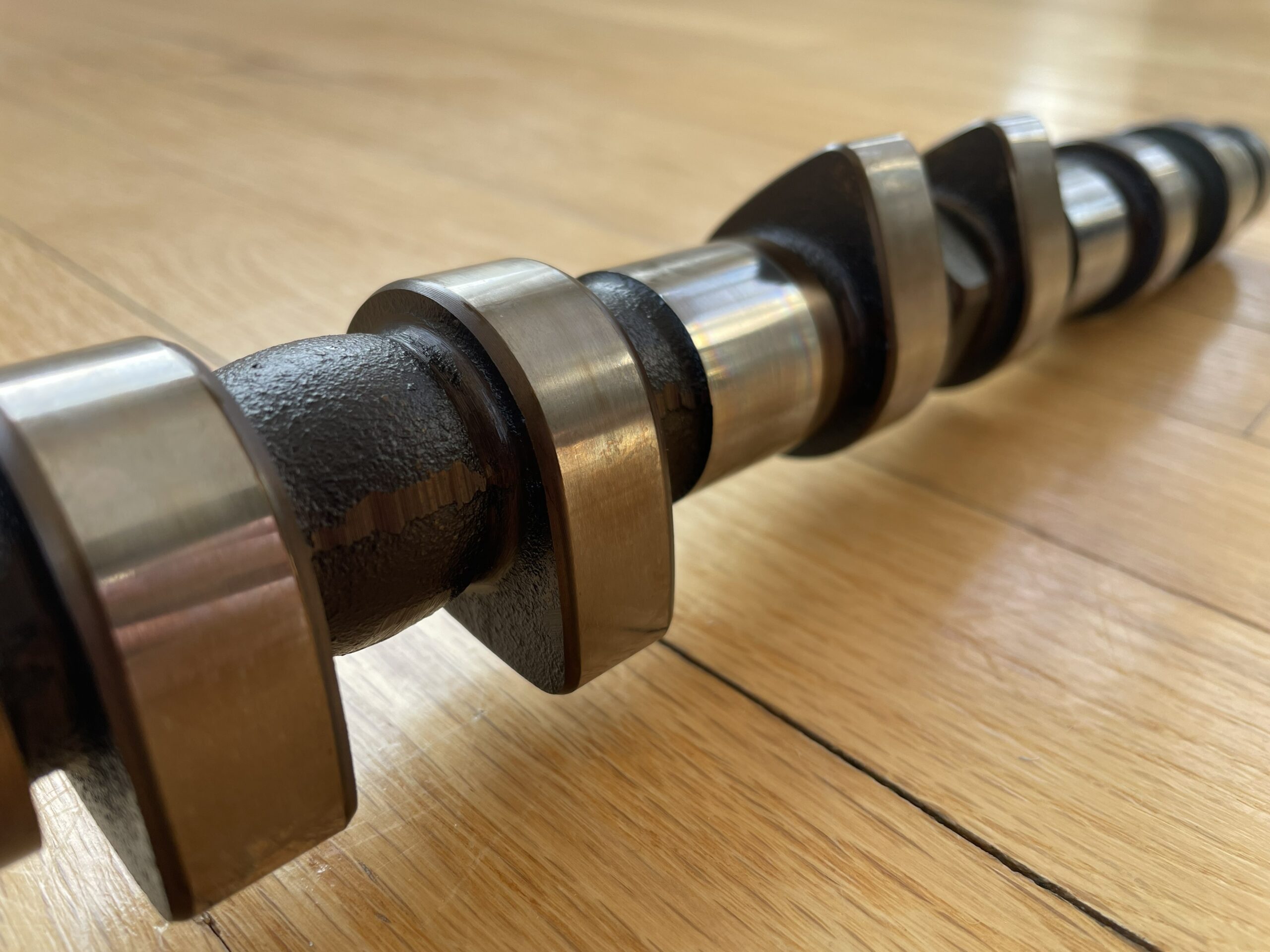
One of the coolest things about the Mercedes M120 V12 is that it exists in this strange space between luxury and motorsport potential. This post covers the three options I considered for upgrading camshafts on a Mercedes M120.
From the factory, it’s a 6.0-liter masterpiece designed to move an S-Class with effortless smoothness. It was never meant to be a high-strung race engine. It was meant to idle like a turbine, pull like a freight train, and do it all without drama.
But that’s exactly why it’s so interesting to build.
Because underneath that refined exterior is massive displacement, an exotic cylinder count, and an engine architecture that feels like it wants to breathe harder than Mercedes ever allowed it to.
My goal with Project Snowball is a high compression, high revving naturally aspirated M120. No boost. No shortcuts.
And if you’re building an NA engine seriously, camshafts are not an optional detail. They are the entire personality of the engine.
Right now, I’m deep in the research stage: trying to understand what the stock cams do, what common regrinds offer, and what happens when you step into the aggressive motorsport-level options.
OEM M120 Cam Specs: The Baseline Mercedes Gave Us
Before looking at upgrading camshafts on a Mercedes M120, it helps to understand what Mercedes designed the M120 to be.

The factory camshafts are relatively mild, which makes sense. This was a luxury performance engine, not a track engine. Smooth idle, strong low-end torque, clean drivability.
Here are the OEM camshaft specifications I’m using as a baseline reference for the M120. These numbers are compiled from available community documentation.
- Duration: 200° intake / 217° exhaust (@ 1 mm lift)
- Valve lift: 9.27 mm intake / 9.27 mm exhaust
- Intake lobe centerline: 124° ATDC
- Exhaust lobe centerline: 112.5° BTDC
- Intake opens: 34° ATDC
- Intake closes: 34° ABDC
- Exhaust opens: 31° BBDC
- Exhaust closes: 14° BTDC
- Lobe separation angle: 118.25°
The big takeaway is that these are very mild cams:
- low duration
- moderate lift
- wide LSA
- minimal overlap
- smooth idle and vacuum
That’s perfect for an S600.
But it also means that if you raise compression, improve flow, and chase rpm, the factory cams eventually become the limiting factor.
At a certain point, the heads and displacement want more air than the stock valve events will allow.
Why Camshafts Matter So Much in an NA Build
Boosted engines can make power by forcing air in.
Naturally aspirated engines have to earn every horsepower the hard way.
That means:
- cylinder filling
- volumetric efficiency
- airflow at high rpm
- scavenging
- valve timing optimization
If I want this M120 to approach something like 750 horsepower NA, the cams can’t stay in luxury mode.
Regrinds: The Fast Road Option
The most common upgrade path for engines like this is a regrind.

You send in your stock cam cores, and a company reshapes the lobes for more duration and lift while keeping things broadly compatible with OEM architecture.
A popular example for the M120 is the Dbilas “road” regrind:
- Duration: 260° intake / 258° exhaust (likely @ 1 mm lift)
- Valve lift: 10.2 mm intake / 10.0 mm exhaust
- Intake lobe centerline: 126° ATDC
- Exhaust lobe centerline: 112° BTDC
- Intake opens: 4° BTDC
- Intake closes: 76° ABDC
- Exhaust opens: 61° BBDC
- Exhaust closes: 17° ATDC
- Lobe separation angle: 119°
Compared to stock, this is a noticeable increase:
- more duration
- more lift
- more overlap
- more top-end breathing
But it still lives in the world of “fast road” cams.
This kind of profile makes sense for someone who wants:
- more power up top
- a sportier character
- but still wants the car to idle reasonably
- and still wants street manners
If your M120 build is a strong NA street car, the Dbilas approach is probably the sweet spot.
The Aggressive Option: Cat Cams
Then there’s the other path for upgrading camshafts on a Mercedes M120.
The one I keep coming back to.
Unlike the Dbilas option—which is fundamentally a regrind of the factory cam cores—the Cat Cams route is a completely different category. Cat Cams produces both cast and billet/steel camshafts depending on the application, but for niche engines like the M120, the offerings are new steel/billet-style performance cams.
That distinction matters, because you’re no longer constrained by the stock cam’s base-circle geometry in the same way a regrind is.

Cat Cams lists a much more serious high-rpm profile for the M120 (profile data below is based on the published cam card/vendor spec “4001056” for this grind):
- Duration: 270° intake / 266° exhaust (@ 1.0 mm lift)
- Valve lift: 13.20 mm intake / 13.00 mm exhaust
- Intake lobe centerline: 106° ATDC
- Exhaust lobe centerline: 106° BTDC
- Intake opens: 29° BTDC
- Intake closes: 61° ABDC
- Exhaust opens: 59° BBDC
- Exhaust closes: 27° ATDC
- Lobe separation angle: 106°
These numbers are not subtle.
This is not a mild upgrade.
This is a camshaft designed for an engine that wants to live at high rpm.
And the lift at TDC tells you immediately what kind of cam this is:
- This engine will have real overlap
- It will have that high-rpm scavenging behavior where the motor starts coming alive the harder you spin it
- It will also come with compromises
Which brings me to the real question:
Is this the right cam choice for a 750 hp NA goal?
Honestly… it might be the only kind of cam that gets you there.
Camshaft Terminology
When comparing cams, it’s easy to get lost in numbers. Here’s how I’m thinking about the key terms.
Duration
Duration is how long the valve stays open.
More duration generally means:
- less low-end torque
- more high-rpm power
- more airflow at peak rpm
Valve Lift
Lift is how far the valve opens.
More lift gives more airflow potential, but it also increases:
- valvetrain load
- spring requirements
- clearance risks
- wear
Lift is one of the most powerful levers in an NA build.
Lobe Separation Angle (LSA)
LSA affects overlap.
- Wide LSA = smoother idle, broader torque
- Narrow LSA = more overlap, more top-end aggression
Stock M120 LSA is 118.25°, very mild.
The Cat Cams setup is 106°, which is race territory.
Overlap
Overlap generally helps at high rpm by improving scavenging, but a lot of overlap often comes with tradeoffs on the street, such as:
- rough idle
- poor vacuum
- less street friendliness
That’s the tradeoff.
Regrind Concerns: Reduced Base Circle
One technical issue I’m thinking about with regrinds is base circle reduction.
When you grind a cam for more lift, you often reduce the base circle.
That can introduce concerns like:
- geometry changes
- follower travel limits
- more aggressive ramp behavior
- potential stability issues at high rpm
Some engines with shim setups can have serious problems with thick shims and high rpm.
The M120 uses hydraulic lifters, which avoids shim-ejection horror stories, but the base circle issue still matters when pushing lift and rpm.
Hydraulic Lifters vs Solid: The High-RPM Question
The M120’s hydraulic lifters are great for what Mercedes intended:
- quiet
- self-adjusting
- low maintenance
But aggressive cams, higher spring pressures, and sustained high rpm can start to push hydraulic systems toward their practical limits, depending on oil control and ramp aggressiveness.
Solid lifters offer:
- stability at high rpm
- consistent lash
- better control with aggressive ramps
But they require:
- manual adjustment
- more maintenance
- more commitment
If the Cat Cams route is the goal, solid conversion may become part of the conversation.
That’s one of the realities of chasing NA power at this level.
The Real Fork in the Road: Regrind vs Billet-Style Performance Cams
At this stage, it feels like there are two very different upgrade philosophies:
- Regrind cams (like Dbilas): more streetable, moderate lift, retains more OEM character
- Performance steel/billet-style cams (such as Cat Cams profiles): a much bigger high-rpm commitment, typically paired with more valvetrain work and a more motorsport-oriented result
For most people, the regrind option is probably the right answer for upgrading camshafts on a Mercedes M120.
For my build — aiming for something extreme like 750 hp naturally aspirated — the billet-style cam path feels closer to what the engine would actually need.
But it also means accepting the compromises.
This is the point where camshafts stop being a bolt-on upgrade and start being a decision about what kind of engine you’re building.
And that’s exactly where this project gets interesting.